Original Drama by Jonathan Holloway BBC Radio Drama, Radio 4Extra, Sounds.
An original ghost story for BBC Radio 4’s late night ‘Sting in the Tail’ strand. An Oxford University team prepares for their TV appearance with a weekend away on the Moors. Things go badly wrong and the legacy of that trip comes back to haunt them 20 years later. The production featured both quizmasters – Bamber Gascoigne and Jeremy Paxman.
By Edith Olivier Adapted by Lavinia Murray Directed by Jonathan Holloway Designed by Neil Irish Music by Jon Nicholls
TOURED AUTUMN 2002
2002: The Love Child
“Red Shift Theatre Company has produced an intelligent play which deals with imagination and emotion at its deepest level. Holloway’s direction is snappy, sensitive and superb…Irish’s design is a mini masterpiece of inventiveness. A hugely satisfying production…powerful and intensely moving.” The Stage
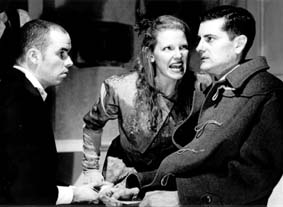
After the death of her mother Agatha Bodenham is left empty and alone. She withdraws from life, absorbed by memories of her childhood, and finds herself increasingly attracted to the spirit world. Then an unearthly young girl arrives and teaches Agatha to live again. They become inseparable, and Agatha will go to any lengths to keep it that way.
Red Shift added a chilling dimension to Edith Olivier’s bewitching novella, The Love Child. A hypnotic story that delved into the power of the imagination, madness and the supernatural.
By Charles Dickens Adapted and Directed by Jonathan Holloway Designed by Neil Irish Music by Jon Nicholl
TOURED 2001 – 2002
2001: Nicholas Nickleby
2001: Nicholas Nickleby
“Brilliant…Holloway’s fine seven strong company lead us through Dickens’ complex story with immense understanding and passion…a brilliant tribute to a great novelist” The Scotsman
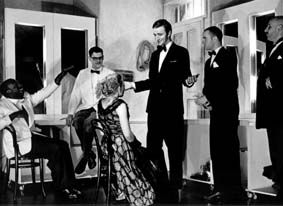
Red Shift’s production of Nicholas Nickleby brought fresh life to a familiar classic confirming the company’s reputation for stunning literary adaptations and rediscovering the punch that made Dickens famous both as a master storyteller and a ground-breaking social commentator.
Relocated to the 1950’s, at a time when British society was revealing its darkest secrets, this powerful story focused on the exploits and adventures of Nicholas who, with his mother and sister, is left destitute after his father’s death. Setting out to rescue his family from misfortune our hero soon finds himself locked into a dangerous conflict with his uncle, Ralph Nickleby, who we see decline into villainy, intent on taking his family with him.
Dickens created in Nicholas Nickleby some of his most memorable characters including the Crummles’ farcical theatrical company, the pathetic and vulnerable Smike, the archetypally wicked Sir Mulberry Hawk and the mindlessly cruel Wackford Squeers, the infamous headmaster of Dotheboys Hall.
An inventive, exciting and intellectually satisfying retelling of a classic story with dramatic drive and a sharp contemporary resonance.
Published by Samuel French Also directed by Jonathan with students of GSA/Surrey University 2012
By GK Chesterton Adapted by Jonathan Holloway Guest Directed by Ben Harrison Designed by Neil Irish Music by Philip Pinsky
TOURED SPRING 2001
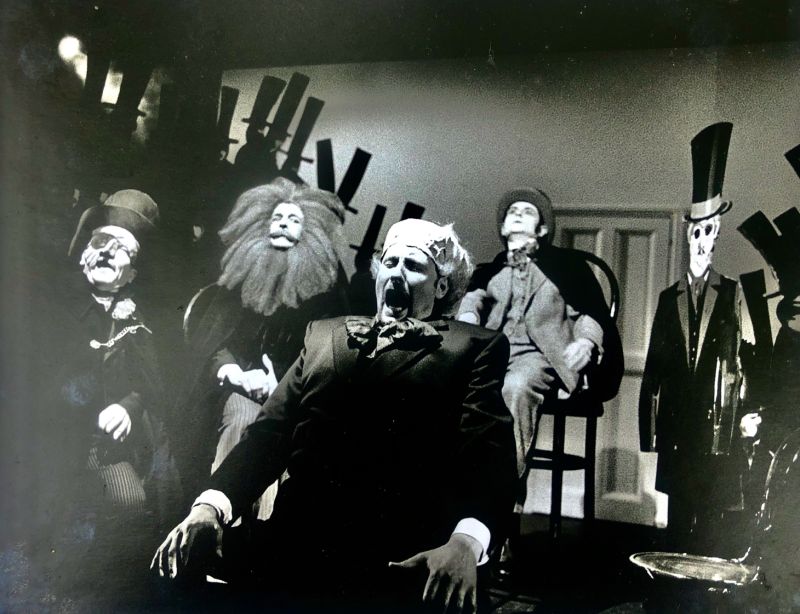
The Man Who Was Thursday is a surreal thriller set in London at the turn of the century. Chesterton’s spy fantasy is considered by many to be his masterpiece.
The story’s hero, Gabriel Syme, an undercover detective, infiltrates a secret council of revolutionaries, named after the days of the week. The group, led by the terrifying and grotesque ‘Sunday’, is dedicated to the destruction of society. Syme, posing as an anarchist, gets himself voted onto the council as the new ‘Thursday’ and sets out to foil their evil plans and single handedly save his world. On the perilous journey that follows, we encounter farcical events, a twisting plot and a series of dramatic revelations which crank up the tension as the true identities of the council are revealed one-by-one.
Based loosely on Bram Stoker’s Dracula Written & Directed by Jonathan Holloway Designed by Jamie Vartan Music by Jon Nicholls
TOURED AUTUMN 2000
2000: Nosferatu
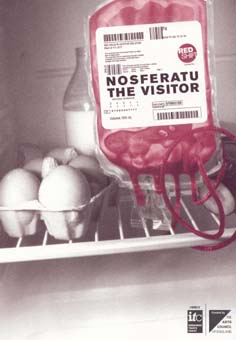
A doctor from Transylvania is buying-up disused hospitals in London and turning them into clinics that provide a miracle cure – transfusions that ‘clean’ the blood. People in search of an antidote to their directionless lives flock to the doctor hoping for an answer. But the treatment has a sinister effect.
Based loosely on Bram Stoker’s Dracula, Nosferatu The Visitor shifted the action to 1940’s London where an evil presence stalked a collection of disillusioned characters ripe for infection. With nothing as it seemed, this unsettling new play added a terrifying twist to the familiar vampire tale.
Also produced in 2010 with students of E15 Acting school School, 2010
Directed by Jonathan Holloway Designed by Neil Irish Music by Jon Nicholls
TOURED 1999 – 2000
Red Shift celebrated 18 years of touring the UK with this vital, groundbreaking production of Shakespeare’s Hamlet. Based on the first quarto version, collected from the actors who originally performed it, Hamlet: first cut is as close as we can get to the popular play seen on the Jacobean stage.
1999: Hamlet First Cut
In this fast-paced urban thriller the young prince is at the centre of a paranoid world: a Denmark in constant readiness for war, Military aircraft roar overhead, as the younger members of society cling desperately to the optimism of youth.
A set of jagged rusting steel and a bold original soundtrack created a striking post-industrial landscape. Powerful performances delivered some of the best words uttered in the history of theatre and costumes were provided by daring British designers – Red or Dead.
A theatrical experience that took Red Shift into the new millennium with a bang.
By Vanessa Brooks Directed by Jonathan Holloway Designed by Neil Irish Music by Paul Clark
TOURED AUTUMN 1998
Vanessa Brooks’ hilarious new play plunged us into a vivid, warts-and-all portrait of seventeenth century London.
Following a two year separation, Elizabeth Pepys – virtuous, sensitive and shrewd – returns to married life alongside her famous diarist husband, Samuel. Middle-aged at twenty-five, harboring a dangerous secret and longing for the child Samuel refused to give her, Elizabeth is surrounded by political intrigue, philandering, disease and vice. This period helter-skelter raced us through fourteen years in the Pepys household. Embracing both the Plague and the Great Fire, a truly side-splitting comedy leading to an unexpected and moving climax.
Based on material from Samuel Pepys’ diary, this witty and shocking new play took Red Shift back to the fertile territory which marked some of it’s most popular work. Le Misanthrope, The Life and Times of Fanny Hill and George Dandin were all new versions of classic texts, commissioned from hugely talented writers and given a surprising, controversial and above all entertaining spin.
By Henry James Adapted and Directed by Jonathan Holloway Designed by Neil Irish Music by Paul Clark
TOURED SPRING 1998
1998: The Aspern Papers
Far from the busy tourist trails, in the crumbling back-streets of Venice, an old woman lives in quiet obscurity. She is attended by her plain, earnest ‘neice’ – a middle-aged woman who has never experienced life outside the walls of their deserted palazzo. Neighbours think they may be witches, they are very rarely seen. This isolated world is shattered by the arrival of Henry James – a charming, lively and determind American academic.
Henry is obsessed by Jeffrey Aspern, a renowned poet of world stature. The old woman – Julianna – was said to be Aspern’s lover and confidante, and Henry belives she possesses a remarkable archive of the dead man’s letters and unpublished works. He wants access to those memories, contained in the tapes she listens to, the papers she pours over. Henry is there to plunder Julianna’s past, is prepared to do whatever is necessary, and once installed in the household sets about the ruthless seduction of her unsuspecting niece. It is a psychological game. Henry and the old woman manoeuvre around each other with the cunning of chess players. But who is the finer player, and can there be a winner?
By Victor Hugo Adapted and Directed by Jonathan Holloway Designed by Neil Irish Music by Paul Clark
TOURED 1997
Paris 1832. Angry crowds swarm in the street. A tinder box atmosphere. Jean Valjean, a fugitive from the law, has transformed himself from petty criminal to wealthy industrialist and moral guardian of a child – Cosette. Relentlessly pursued by the obsessive Inspector Javert, Valjean attempts to save his precious new world from discovery and ruin. How can he protect Cosette and still maintain his new identity? How can he stand the pain of parting if her safety and happiness depend on it?
This new version of a truly great novel was one of Red Shift’s most celebrated touring productions. Characterised by changes of mood from knock-about comedy to moments of almost unbearable emotion, this life-affirming roller coaster evening caught the imagination of audiences throughout the country – audiences who cheered the committment and energy of a remarkable ensemble.
With live music influenced by Breton Folk and Urban Jazz, Red Shift’s Les Miserables combined the essence of 19th century France with the colours, anger and energy of contemporary street culture.
Adapted by Jonathan Holloway. With original music by Ross Brown. An early example of Holloway’s radio work. A very ambitious 90 min adaptation of the ‘Western’ set ghost story by Willa Cather.




 Jonathan Holloway